
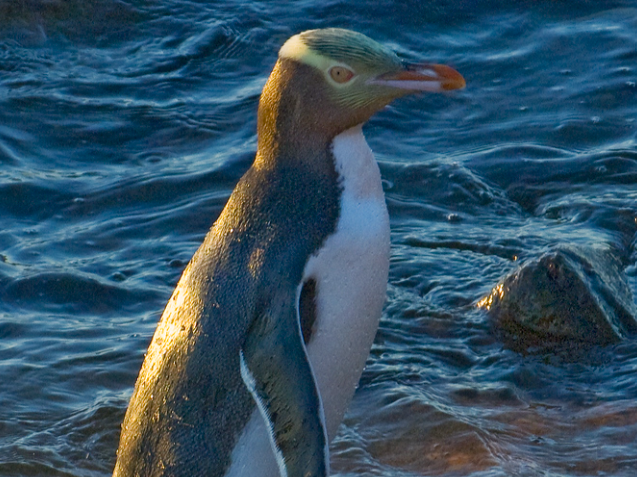
The Environmental Law Initiative has received the High Court judgment from its urgent hearing against the Minister for Oceans and Fisheries, which challenged the limited scope of the emergency setnet fishing closure implemented to protect hoiho.
The Court described hoiho as “priceless” and a taonga, emphasising that their protection is essential “for its own sake.”
While the Court recognised the severe risk facing northern hoiho, it found the Minister’s temporary emergency closure lawful. It said section 16 of the Fisheries Act gave the Minister significant discretion in establishing the parameters of the emergency closure.
“Although we were not successful on the specific grounds of our judicial review, we are pleased by the very strong statements made by the judge,” says ELI’s Director, Research and Legal, Dr Matt Hall.
“The Court has confirmed that the Minister is required to take whatever measures are necessary to ensure hoiho survival.
“As the judge stated, potential economic detriment to commercial fishers could never be a justification for allowing the decline of the population to continue.
“This is a strong statement that the Minister and Fisheries NZ will now have to contend with in their decision-making on longer-term measures” says Dr Hall.
Both the Crown and Seafood NZ claimed the Fisheries Act is about utilisation of fishing stocks, not a conservation act. However, in its judgment, the Court rejected that characterisation, saying, “Utilisation is permitted only if it can be achieved sustainably. Stocks must be maintained for future generations, and the marine environment must be safeguarded. In considering sustainability measures, the Minister must, among other things, have particular regard to kaitiakitanga.”
The Court made clear that Fisheries New Zealand must now consider ELI’s scientific critiques and newer modelling in shaping long‑term measures. This includes modelling that may identify additional high‑risk areas such as North Otago and Foveaux Strait.
The Court highlighted that “the Minister's objective must be to ensure the number of fishing-related hoiho deaths falls below the level required to ensure the population can recover”, adding “The steps he takes must be reasonably capable of ensuring that objective is achieved.”
Dr Hall says, “If new evidence shows risk remains above sustainable levels, then in our view the Minister will need to adopt more expansive closures or set a low mortality limit.
“This was a novel case. When a taonga species like hoiho is sliding towards extinction, it is essential to take every avenue available to ensure the government meets its responsibilities.
“We welcome the Court’s clear statements confirming that the Act requires whatever measures are necessary to secure hoiho survival. That is a significant outcome for the long‑term future of the species.
“We want to acknowledge the tireless work of all the volunteers and staff dedicated to hoiho conservation. Their efforts remain vital to giving this population a chance of recovery,” says Dr Hall.
Background to the case
In mid‑2025, following the sustained decline of the northern hoiho population - including three penguins killed in a single setnet near the Otago Peninsula - ELI wrote to the Minister of Oceans and Fisheries urging the use of rarely used emergency powers to impose a full‑range set‑net closure across the northern hoiho habitat. In the space of 20 years, the northern hoiho population had lost 80% of nesting pairs. The 2024 count showed just 143 nesting pairs left, spread across the range of hoiho habitat, from Banks Peninsula to Rakiura Stewart Island.
Fisheries New Zealand recommended to the Minister a targeted, temporary ban around the Otago Peninsula rather than a region‑wide closure.
On 11 September 2025, the Minister used his section 16 emergency powers to impose a three‑month set‑net ban extending eight nautical miles around the Otago Peninsula. ELI filed a judicial review of the Minister’s decision, on the grounds that it only closed part of northern hoiho habitat to setnet fishing, when the entire population is at risk of extinction. Hoiho outside of the Otago Peninsula remained vulnerable to setnet fishing deaths.
Just two days before the urgent High Court hearing, a hoiho was found drowned in a setnet off the coast of Rakiura.
ELI’s case was heard in the Wellington High Court from December 1st – 2nd.
In December, the Minister renewed the emergency closure to September 2026 (without changing its size) while consultation began on long‑term measures, including permanent closures and mortality limits. The long-term measures have not yet been publicly announced.