
Minister was required to do better than ‘a coin toss’ on climate
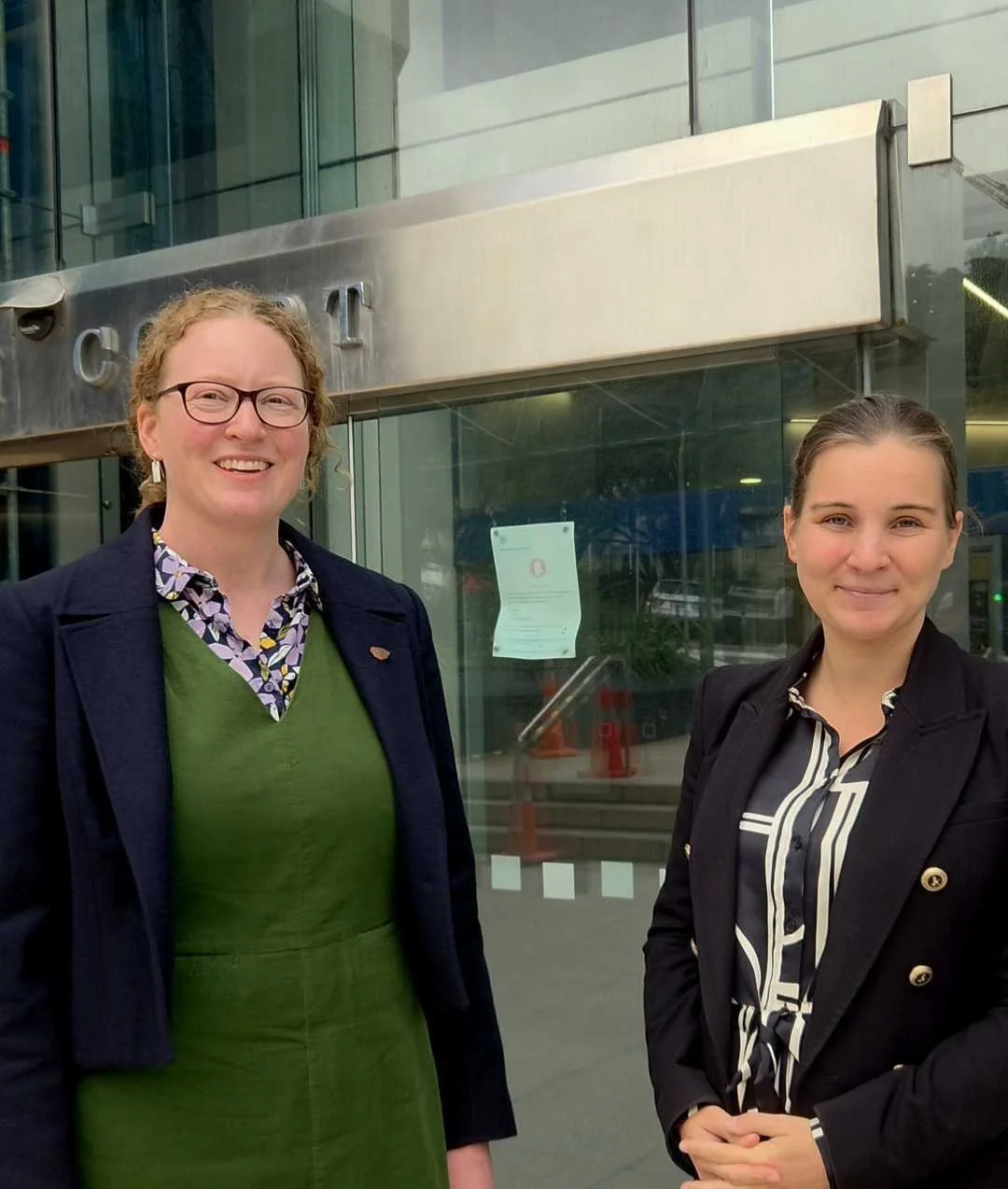
Three days of hearing in the Wellington High Court in Lawyers for Climate Action and Environmental Law Initiative v Minister of Climate Change, concluded this afternoon.
The case has brought significant scrutiny to the actions of the Minister of Climate Change, Simon Watts, in changing New Zealand’s first Emissions Reduction Plan (ERP1), and the subsequent development of the second Emissions Reduction Plan (ERP2).
Photo: Eliza Oldfield Prestidge, ELI, and Jessica Palairet, Lawyers for Climate Action NZ outside the Wellington High Court.
Lawyers for Climate Action’s Executive Director, Jessica Palairet says, “The Minister was required by law to have a high level of confidence that New Zealand’s carbon budget would be met.”
“However, the advice from his officials showed the chances of achieving the second emissions budget were not much better than a coin toss.”
The Minister went on to approve the Second Emissions Reduction Plan anyway, despite the obvious risk it would not achieve meeting the carbon budget.
“In our view, that is a reckless decision made by the Minister, and we have asked the Court to require the Minister to revisit it,” says Palairet.
ELI’s Senior Legal Researcher Eliza Oldfield Prestidge says: “New Zealand’s climate law demands stable policy making and plans that will actually meet our carbon budgets.
“If the best available advice shows there’s only a coin‑toss chance of meeting our carbon budgets, in our view the plan is not lawful, and it’s certainly not fulfilling the level of ambition Aotearoa New Zealand is capable of.”
Over three days, the Court also heard that the Minister weakened the first Emissions Reduction Plan (ERP1) through a flawed process that failed to meet consultation and transparency requirements, cutting over 35 policies and actions.
As reported in media, Boldt J expressed concern from the bench that the process followed by the Government was “fundamentally flawed”.
They also said the Minister was not provided with key information needed to make a legally sound decision on ERP2, including the scientific limitations of treating forestry removals as interchangeable with emissions reductions.
The Crown told the Court it welcomed the scrutiny brought by the case. Eliza Prestidge Oldfield from ELI says “Climate change demands robust accountability and looking behind government spin to make sure they're walking the walk.
“We have asked the Court to declare ERP2 is insufficient to meet the legal standard, and to declare the ERP1 amendments did not follow lawful consultation requirements.
“We want to see the Minister make decisions that provide the people of Aotearoa New Zealand with a high level of confidence that we can meet our climate targets,” says Prestidge Oldfield.
The groups await the Court’s judgment.